
The PRS database for letting agents: access, workload and risk
The PRS database changes what a letting agent is asked to do for every landlord on the books. The landlord starts and finishes each registration, but the agent is likely to be asked to supply most of the property detail, one property at a time, with no bulk upload to help.

On this page
- What can a letting agent do on the PRS database?
- Is there a bulk upload for the PRS database?
- How do invitations and passwords work for agents?
- What if an agent gets an invitation they have not agreed to?
- What happens with joint landlords?
- What happens when a landlord changes letting agent?
- How long will the PRS database take for a letting agent’s portfolio?
- Why is the data for registration spread across five places?
- When will the PRS database workload peak?
- How big is the credential burden for letting agents?
- Should agents charge for registration support?
- What should a letting agent do before their region opens?
- How does licensing risk show up for letting agents?
- Frequently asked questions
What can a letting agent do on the PRS database?
A letting agent can supply the property information the landlord delegates to them, but cannot create the entry, make the declaration or pay. Under draft regulation 4(5), an appointed letting agent or property manager may provide the Schedule 3 Part 2 information on the landlord’s behalf. Everything else stays with the landlord.
The reason is structural. Draft regulation 4(6) says a dwelling entry cannot be made unless there is an active landlord entry first, so the landlord has to start. In the service as shown to industry by MHCLG, the landlord also checks the agent’s work, makes the final declaration and pays the fee. Liability for accuracy stays with the landlord, which is why the question of who checks what belongs in your terms of business.
Landlords use the GOV.UK service “Register your rental property” to add each property (GOV.UK Housing Hub).
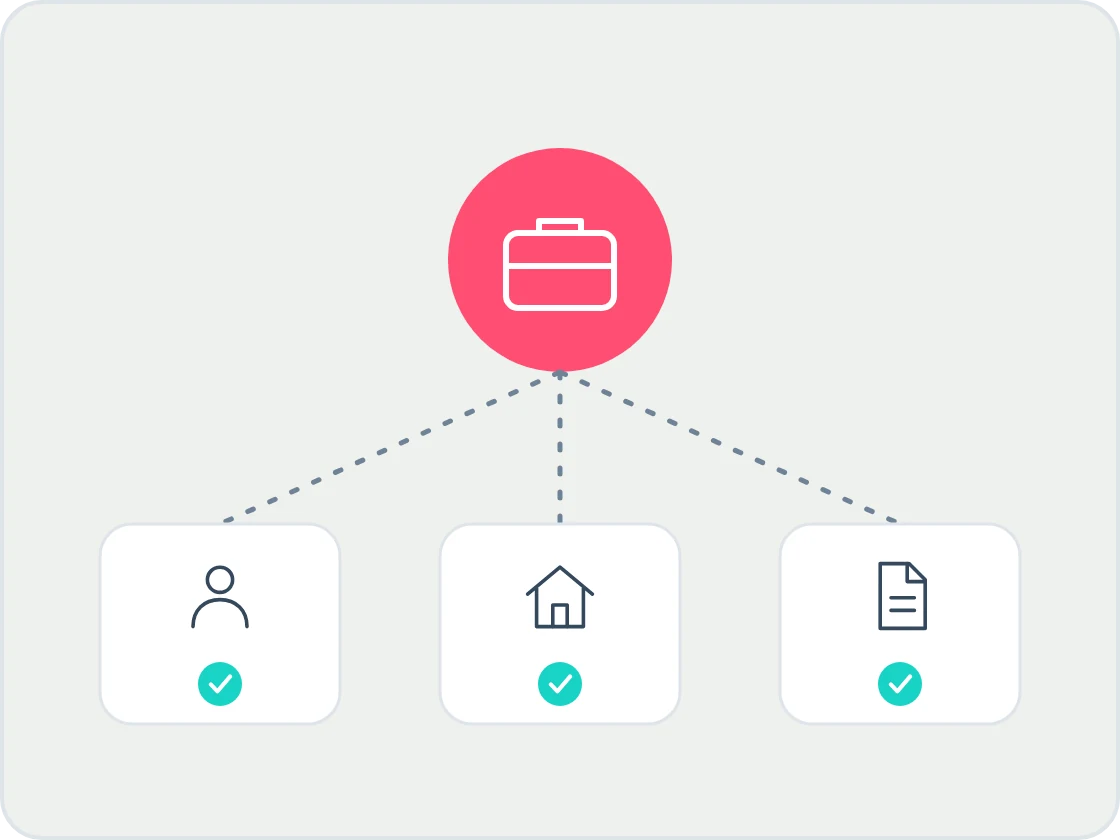
An agent can
- Be nominated for a specific property by the landlord
- Enter the delegated property details within the 28-day window
- Mark gas, electrical and EPC details as “provide this later”
- Hold the property’s access link and password
Only the landlord can
- Create the landlord entry and start each registration
- Choose, appoint and change the nominated agent
- Check the completed information and make the declaration
- Pay the £65 fee, and carry legal responsibility
Is there a bulk upload for the PRS database?
No. The PRS database has no bulk upload at launch, so every property is registered individually. MHCLG told industry it considered a bulk option and chose not to build one at this stage. It may look again in future. Offers from industry to fund a bulk upload were declined.
For an agent, the practical meaning is arithmetic. Each managed home that a landlord nominates you for is one invitation, one password and one set of details to enter. A portfolio of 2,000 homes where every landlord nominates the agent means 2,000 separate invitations. An agent managing tens of thousands of homes could receive tens of thousands.
This is attributed to MHCLG’s autumn 2026 presentation to industry and is subject to change. The industry has also asked whether a single nominated account could cover several properties, and no answer has been published. If one is, this section will change and the change will be dated in the log.
How do invitations and passwords work for agents?
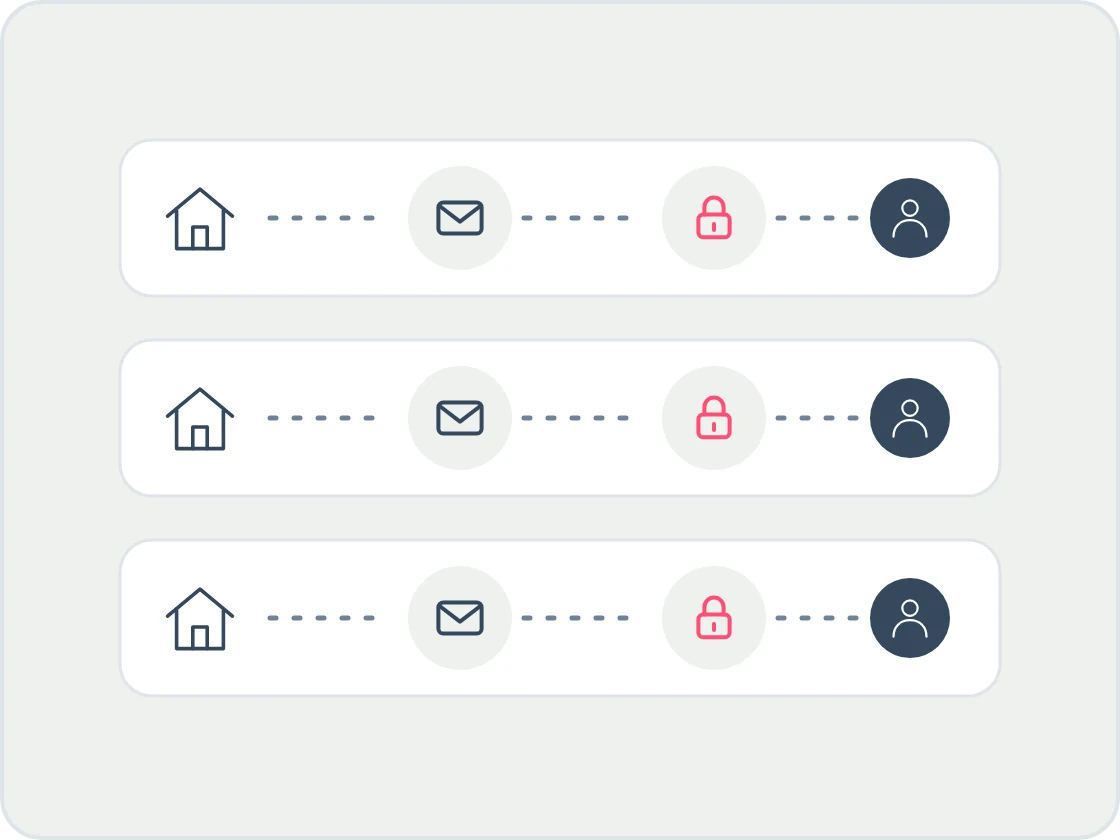
The PRS database gives each property its own invitation and its own access, so an agent holds one credential per property. When a landlord nominates an agent, the agent receives an email invitation for that one property. The agent sets the property’s password, and the password cannot be changed afterwards.
The details are due within 28 days of the entry being made, with a reminder after 14. Outstanding sections show a completion deadline, so a live list of what is overdue is something an agent will want to hold in its own systems as well. Draft regulation 6 sets the 28-day period for Part 2 information.
What if an agent gets an invitation they have not agreed to?
An agent cannot reject a PRS database invitation, and there is no formal accept step either. As shown to industry, a landlord can nominate an agent before the two have agreed the scope, the cost or the process. The invitation can therefore arrive first and the conversation second.
This is the gap that most affects agents commercially. The invitation does not create a contract, and an unaccepted instruction is not an agreed service. The practical protection is in your terms of business: what registration support is included, what it costs, what the landlord must supply and what happens when you have not accepted an instruction. What should agents put in their terms of business?
In practice, agree this with each landlord before the region opens, so the invitation arrives into a conversation that has already happened. Take legal advice on any wording you adopt.

What happens with joint landlords?
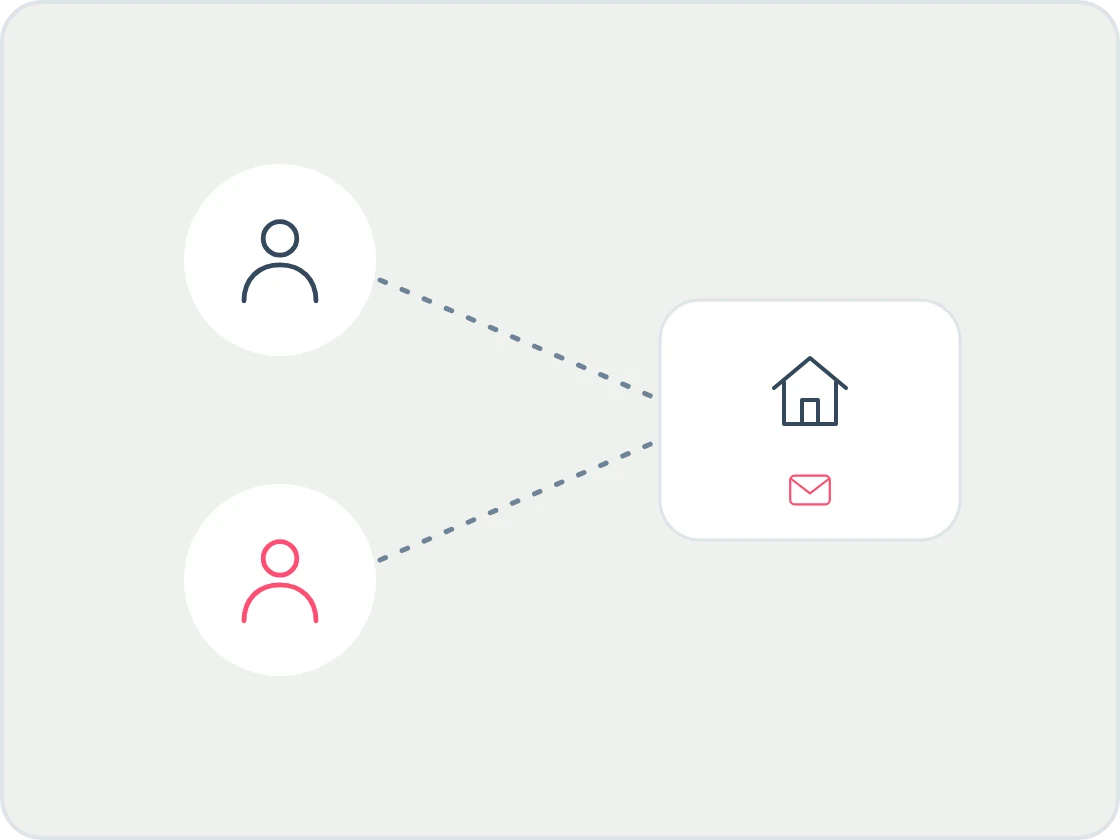
Joint landlords each take part in the registration, which adds steps to every property they own together. Each landlord completes their own part, and only the nominated party handles the delegated section. For an agent, that means chasing more than one person to finish a single entry.
This is the part of the process most likely to slow an otherwise ready property. A record that lists more than one owner needs each of them to act before the entry can be completed, and the agent is waiting on the slowest. Check your landlord records for jointly owned properties now, and note who your main contact is for each.
The information required of each landlord is covered in the information checklist.
What happens when a landlord changes letting agent?
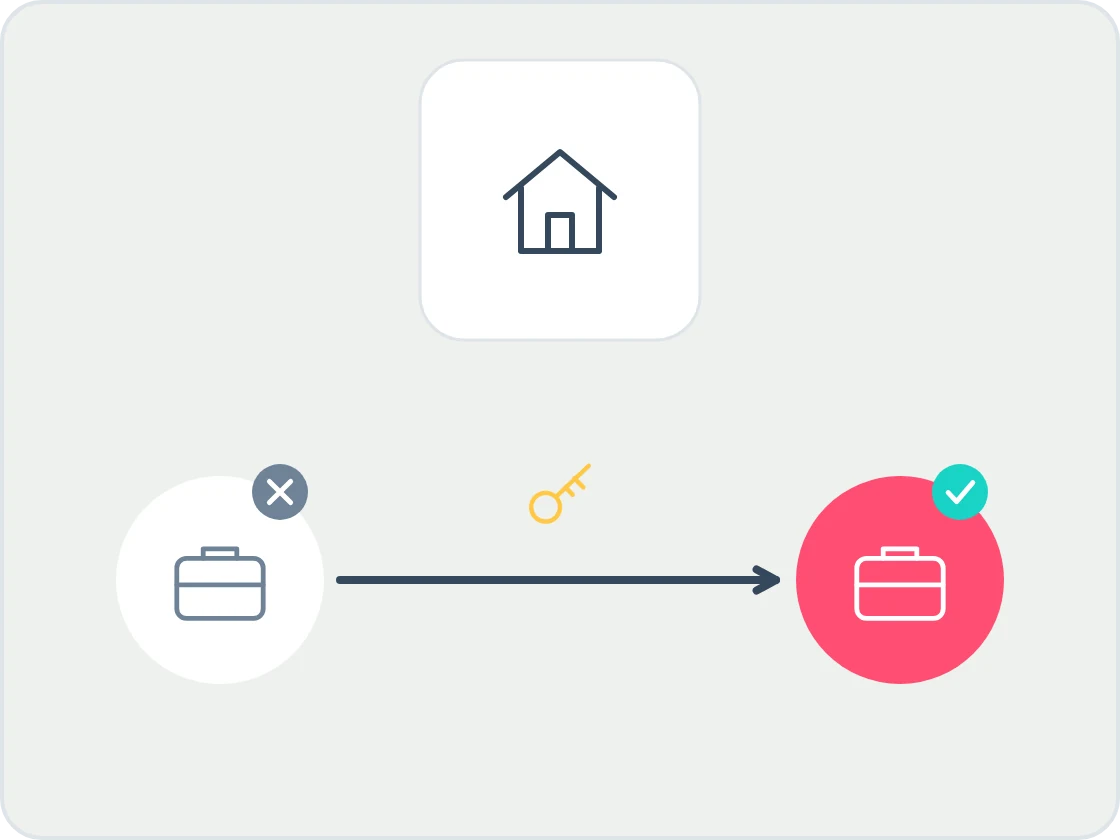
The PRS database ties the nominated agent to each property, so a landlord who changes agent is likely to have to update every property they own. This is our reading of the per-property model, not something the government has confirmed, and it may change.
For the outgoing agent, it raises a question that terms of business seldom answer: what happens to the access you hold on properties you no longer manage. Because the password cannot be changed, we would treat it as a live credential until the landlord has replaced the nomination. For the incoming agent, every transferred property starts as a fresh invitation.
Both sides benefit from a written handover. It should record which properties have been registered, which sections are outstanding and when the 28-day period ends.
How long will the PRS database take for a letting agent's portfolio?
Entering a portfolio on the PRS database takes between 17 hours for 100 homes at the government’s estimate and about 4,200 hours for 10,000 homes at the prototype-agent estimate. The government estimates 10–15 minutes per property. Agents involved in prototype testing say 20–25 minutes. Both figures are industry-sourced and may change.
The table multiplies each estimate across four portfolio sizes. It counts portal entry only, which is the time spent completing the delegated sections once the information is in front of you. It excludes gathering the data, chasing documents, quality checks, corrections and annual renewal, and for many agents will add to the figures shown.
| Managed homes | At 10–15 min (government estimate) | At 20–25 min (prototype agents) | FTE-weeks, across both estimates |
|---|---|---|---|
| 100 | 17–25 hours | 33–42 hours | 0.4–1.1 weeks |
| 500 | 83–125 hours | 167–208 hours | 2.2–5.6 weeks |
| 2,000 | 333–500 hours | 667–833 hours | 8.9–22.2 weeks |
| 10,000 | 1,667–2,500 hours | 3,333–4,167 hours | 44–111 weeks |
Assumptions. One FTE-week is 37.5 working hours. The last column spans the shortest and longest figures in the row. Every landlord is assumed to nominate the agent, so these are upper bounds on invitations received. Portal entry only. Minutes per property as stated above: government estimate from MHCLG, prototype-agent estimate from agents involved in prototype testing. Both as presented to industry in autumn 2026.
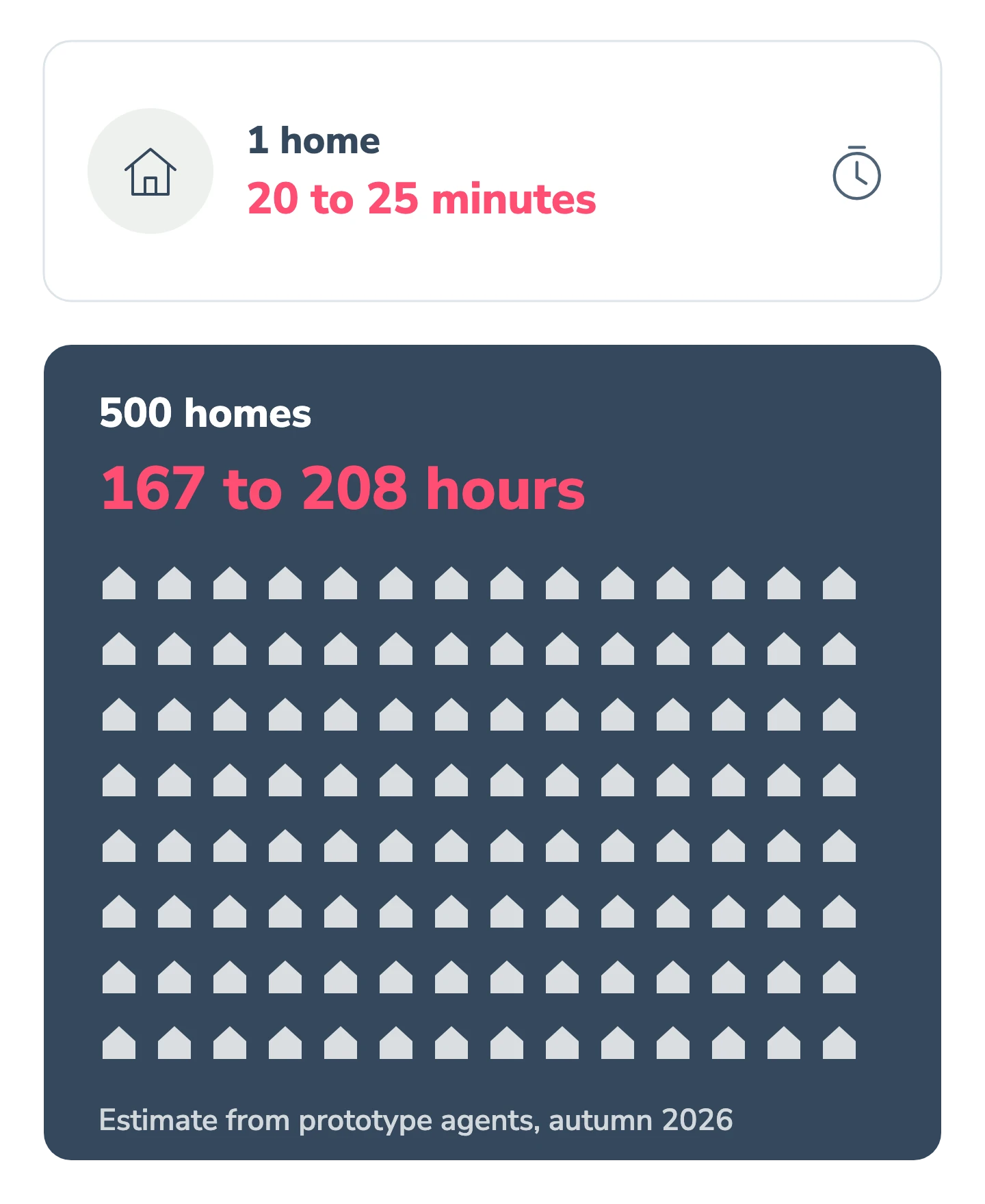
A worked example makes the scale concrete. An agent managing 500 homes, with every landlord nominating it, faces 500 invitations. At 20–25 minutes each, that is 167–208 hours of portal entry, or 4.4 to 5.6 weeks of one person’s full-time work, before any data has been gathered. At 10–15 minutes it is 83–125 hours.
Why is the data for registration spread across five places?
The information the PRS database asks for is rarely in one system. A typical managed property has its tenancy details in the CRM, its licence in a separate file, its certificates in a document store, its ownership known to the landlord and some of its history on paper. Completing a registration means collecting from each.
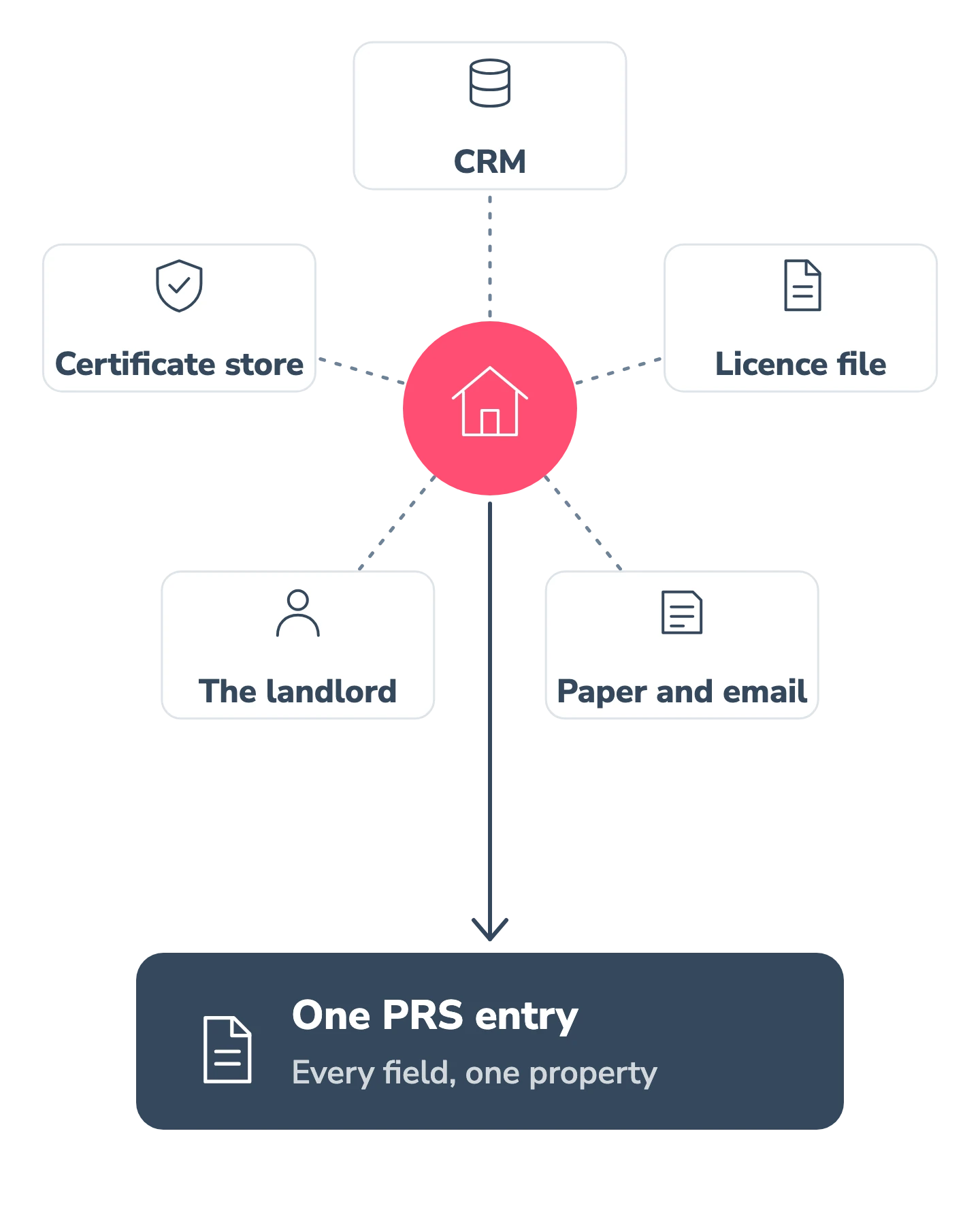
| Where it lives | What is usually there | What is often missing |
|---|---|---|
| CRM or property system | Rent, tenancy dates, occupant names | Number of households; licence number |
| Licence file or spreadsheet | Licence type and expiry | Application references; renewal dates |
| Certificate store | Gas safety, EICR, EPC | Out-of-date or absent records |
| The landlord | Ownership details, joint owners | Often not recorded centrally |
| Paper | Older licences and certificates | Anything not yet scanned |
The standout gap is the number of households in each property. Most property systems do not hold it, while licensing data often does. Licence numbers are also frequently not recorded centrally, and safety documents may be missing or out of date. Each gap is a delay on an individual property, and the information required for each field is set out in the information checklist.
When will the PRS database workload peak?
The workload peaks in the weeks before each regional deadline, because every region has a three-month window and the deadline is set by where the property is. An agent with homes in several regions meets several peaks. The West Midlands window runs from 15 December 2026 to 14 March 2027, and the 8 windows after it follow at monthly intervals.
Take 2,000 homes in a single region. At 20–25 minutes each, portal entry comes to 667–833 hours. Spread evenly across a window of about 13 weeks, that is 51–64 hours every week, or between 1.4 and 1.7 full-time staff, with no allowance for holidays, missing data or late landlords. Real portfolios will bunch towards the deadline. The West Midlands window also includes the Christmas period.
Registering early spreads the work, which is the most useful single lever an agent has. The full list of dates is in the rollout table, and each region has its own page.

How big is the credential burden for letting agents?
One password per property makes credential handling a real task rather than a theoretical one. An agent that sets a unique password for each of 500 properties holds 500 credentials, and each has to be stored, found, and tracked against the landlord, the property and the deadline.
We are not suggesting that this is a cause for alarm. It is a manageable but new data-handling duty, and the passwords cannot be changed once set. Sensible practice covers four points:
- Store credentials in a password manager or access-controlled system, not a spreadsheet or email thread
- Record which properties each member of staff can reach
- Decide in advance who looks after credentials when someone leaves the team
- Keep a log of when each credential was created, so a handover can be audited
Do not reuse one password across properties. It is the simplest route to a problem that a per-property design is meant to avoid.

Should agents charge for registration support?
Whether to charge is a commercial decision for each agent, and the terms of business should settle it before the region opens. Registration support is new work that is not covered by most existing agreements. Some agents have said they expect to charge an administration fee, and many others are still deciding.
A clear position helps both sides. Agents who handle registration should say what is included, what it costs, what the landlord must supply and who checks the result. Agents who do not should say so, so that landlords know to complete the nomination themselves. We do not suggest a price. Our checklist of what to put in terms of business lists the points to cover, and every agent should take legal advice on the wording.
Registration also changes how a property is advertised. Once the marketing rule starts, a property without active entries cannot be marketed, and adverts must carry the registration IDs. Do adverts need a PRS database registration number?
What should a letting agent do before their region opens?
Start with the information, then the agreements, then the order of work. The checks below turn the operational points on this page into a sequence that an agent can begin before the portal opens on 15 December 2026, without needing any access to the service.
- Audit your data. For every managed property, record whether you hold the number of households, the licence type and number, and current gas, electrical and EPC evidence. Mark every gap.
- Agree your terms. Decide whether registration support is part of your service, what it costs and who checks it. Update your terms of business after legal advice.
- Sequence by region. Group managed homes by region and by deadline. Begin with the first region that opens, and start earlier than the deadline requires.
- Capture landlord consent. Record that each landlord authorises you to act, will supply what you need and will check and submit the final declaration themselves.
- Check the licensing answer. The registration asks for the licence type and number under a false-information warning. Confirm which of your properties are licensable, and which are licensed, before a landlord has to declare it.
- Plan the credentials. Decide where each per-property password will be stored and who will have access.
How does licensing risk show up for letting agents?
Each PRS database entry asks for the property’s licence type and number, and councils can see the answer. A landlord who declares a licence they do not hold may commit an offence, and a licensable property without a licence becomes easier for a council to find. For an agent, that makes the licensing audit part of registration readiness.
The penalties are set out in the hub’s penalty table. Registration carries a civil penalty of up to £7,000, or £40,000 for false information, once those provisions are in force, which they are not yet (Renters’ Rights Act 2025, s.91 and s.92). Licensing offences committed on or after 1 May 2026 carry up to £40,000 (Housing Act 2004, s.249A), and a rent repayment order of up to 24 months’ rent. The full argument is on the PRS database and property licensing page.

Frequently asked questions
Not on their own. The landlord must create the entry, make the final declaration and pay. A letting agent or property manager can be appointed to provide the Part 2 property information under draft regulation 4(5). The landlord remains responsible for its accuracy.
No. The landlord pays the fee when they submit the registration. An agent may charge its own administration fee for the work, which is a matter for its terms of business.
There is no reject option in the service as shown to industry. An agent can decline to act and should tell the landlord promptly, but the invitation will remain. Agree the position in your terms of business before invitations arrive.
Not in the service as shown to industry, which uses one invitation and one password per property. The industry has asked whether a single account could cover several properties. No answer has been published, and this may change.
Part 2 information must be provided within 28 days of the entry being made, with a reminder after 14. Gas, electrical and EPC details can be marked “provide this later” within that period. Missing the period is a landlord compliance risk, so agree who monitors it.
At the government’s estimate of 10–15 minutes per property, about 83–125 hours. At the 20–25 minutes reported by prototype agents, about 167–208 hours. Both are portal entry only and exclude data gathering. Calculate your portfolio →
The draft regulation refers to a letting agent or property manager. The final definition of an eligible third party is one of the points the industry has asked the government to clarify.
Landlords can only delegate by nominating the agent in the service, so the agent would find out through the invitation. Both sides are better served by a conversation first. How does a landlord nominate an agent? →
Find your gaps before your landlords' deadlines.
See which of your managed properties are licensable, which are licensed and where the licensing answer is missing, before your region opens.
