
PRS database time calculator: how many hours will your portfolio take?
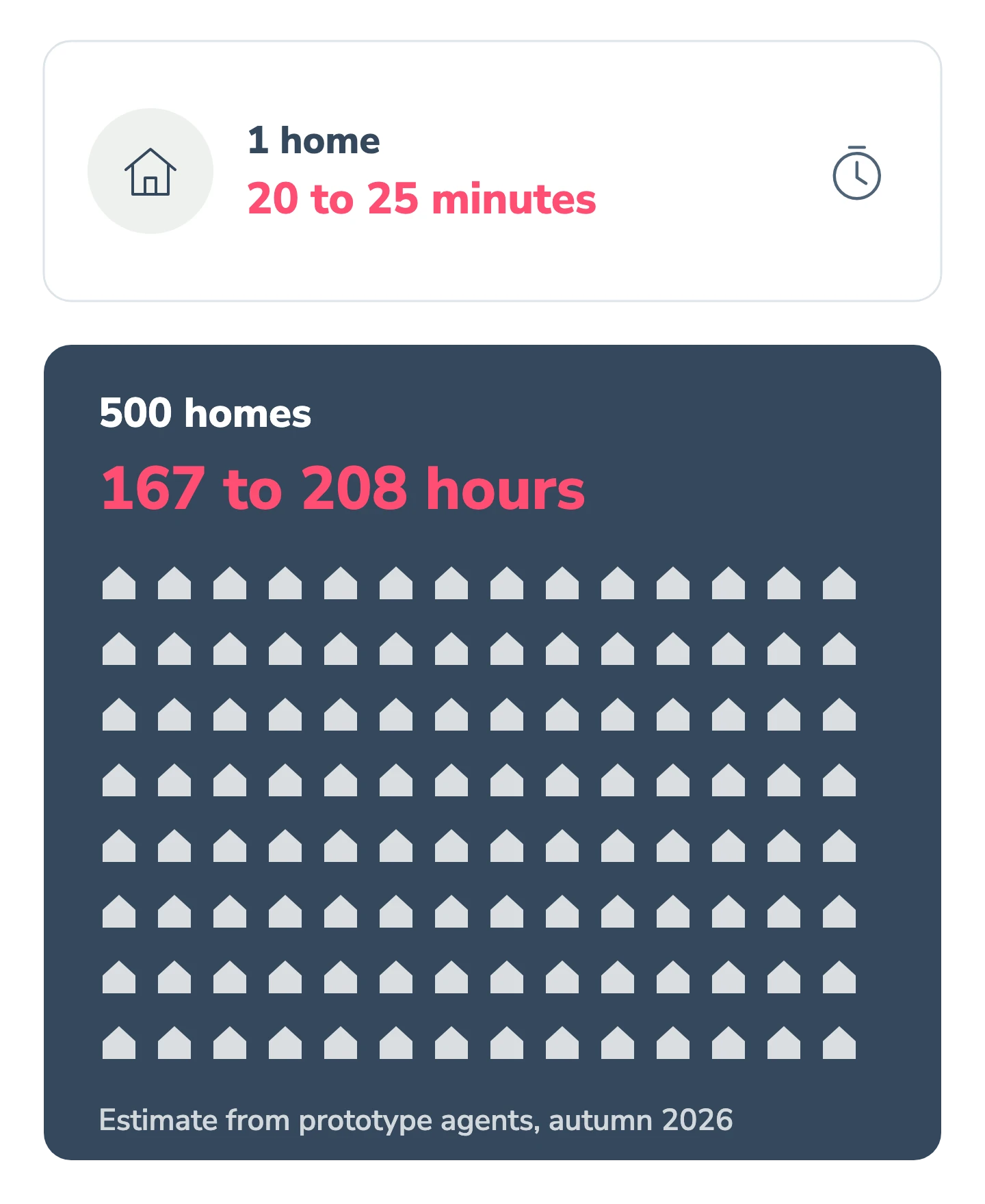
Entering one property on the PRS database takes between 10 and 25 minutes, depending on whose estimate you believe, and every managed home needs its own entry. For 500 homes that is between 83 and 208 hours of portal work, before any data has been gathered.

On this page
- How long will it take to register a portfolio on the PRS database?
- What do the results look like for common portfolio sizes?
- What does a worked example look like?
- What does the calculator leave out?
- Why do the two estimates differ?
- How should you use the result?
- What’s changed
- Frequently asked questions
How long will it take to register a portfolio on the PRS database?
Registering a letting agent’s portfolio on the PRS database takes the number of properties multiplied by the minutes each entry needs, and only the landlords who nominate your agency count towards your workload. Use the calculator below, or read the answer for common portfolio sizes in the table that follows it.

The calculator needs JavaScript. The tables and worked example below give the same answers.
- Entries you complete
- Portal hours
- Full-time staff weeks (37.5 h)
- Staff cost
Government fees, paid by your landlords (not your cost)
What do the results look like for common portfolio sizes?
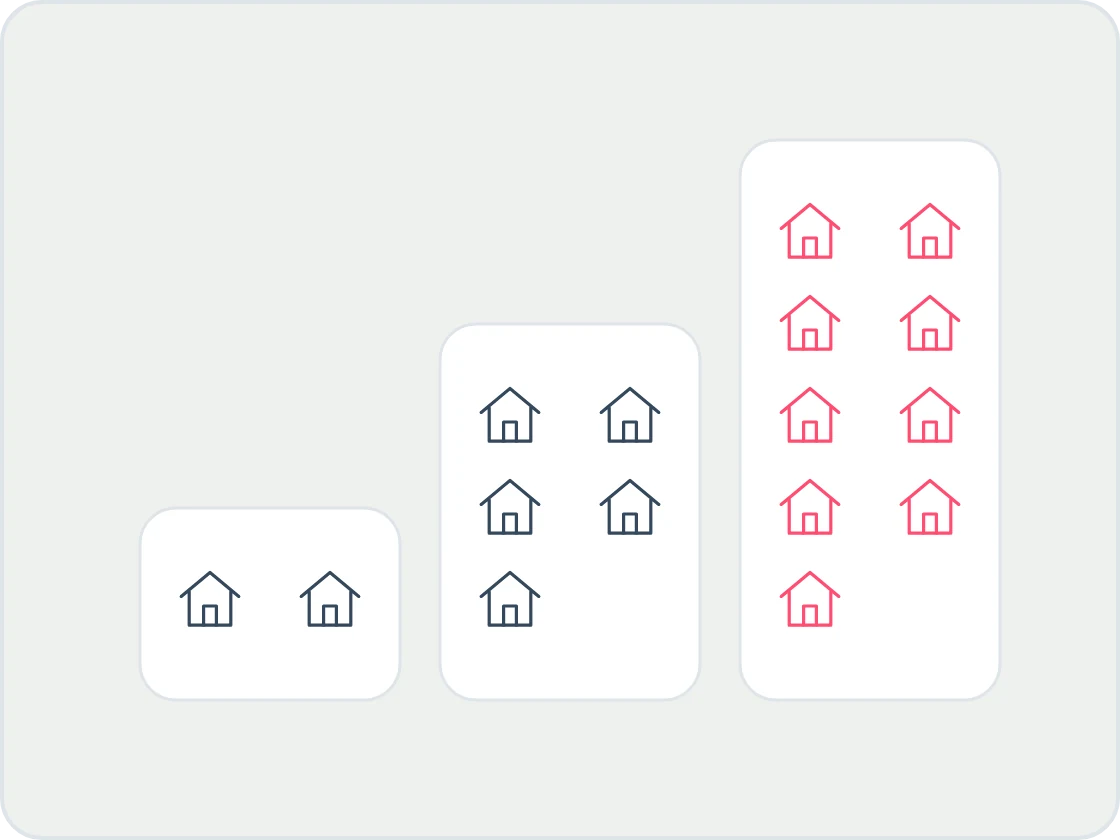
A portfolio of 1,000 homes needs between 167 and 417 hours of portal entry, which is between 4.4 and 11.1 full-time staff weeks, depending on whether the government’s estimate or the prototype agents’ estimate holds. The tables below assume every landlord nominates the agency and a staff cost of £25 an hour.
| Homes managed | Government estimate (10 to 15 min): hours (staff weeks) | Prototype agents (20 to 25 min): hours (staff weeks) |
|---|---|---|
| 50 | 8 to 13 (0.2 to 0.3) | 17 to 21 (0.4 to 0.6) |
| 250 | 42 to 63 (1.1 to 1.7) | 83 to 104 (2.2 to 2.8) |
| 1,000 | 167 to 250 (4.4 to 6.7) | 333 to 417 (8.9 to 11.1) |
| 5,000 | 833 to 1,250 (22.2 to 33.3) | 1,667 to 2,083 (44.4 to 55.6) |
| Homes managed | Staff cost, government estimate | Staff cost, prototype agents | Government fees (paid by landlords) |
|---|---|---|---|
| 50 | £208 to £313 | £417 to £521 | £3,250 |
| 250 | £1,042 to £1,563 | £2,083 to £2,604 | £16,250 |
| 1,000 | £4,167 to £6,250 | £8,333 to £10,417 | £65,000 |
| 5,000 | £20,833 to £31,250 | £41,667 to £52,083 | £325,000 |
The fee column is not part of an agent’s cost: the government fee, paid by landlords, is the larger sum; the staff time falls on the agent. Each landlord pays the £65 per property, per year, when they submit their entry, and it is pro-rated during the rollout. We show it because an agent’s landlords will ask about it, and because it is larger than the staff time at every size. How much does registration cost?
Sources for the minutes: the 10–15 minute range is the government’s estimate and the 20–25 minute range comes from agents involved in prototype testing, both as shown to industry in autumn 2026 and subject to change.
What does a worked example look like?
A letting agent managing 500 homes, with every landlord nominating the agency, needs between 83 and 125 hours of portal entry on the government’s estimate and between 167 and 208 hours on the prototype agents’ estimate. That is 500 entries, each started by a landlord and each completed by the agency, one invitation at a time.
At £25 an hour the staff time costs between £2,083 and £3,125 on the government’s estimate and between £4,167 and £5,208 on the prototype agents’ figure. On the longer estimate, one person doing nothing else would need between 4.4 and 5.6 working weeks. In the same example the landlords pay £32,500 in government fees between them. That sum is theirs, not the agency’s, and it does not change with the minutes per property.
Now suppose only 60% of the landlords nominate the agency and the rest complete the entry themselves. The agency handles 300 entries, which is 100 to 125 hours on the longer estimate and 50 to 75 hours on the shorter one. The share of landlords who nominate you is the lever that moves the answer most, and it is a decision your landlords make property by property. Can a letting agent register a property for a landlord?
What does the calculator leave out?
The calculator counts only the minutes spent entering a property’s details in the government service. It excludes everything that happens before and after, and for most agencies those steps are larger than the entry itself. Read the results as a floor for the workload, not a forecast of it.
- Finding the data. Number of households, licence numbers and certificate dates are often held in a CRM, a spreadsheet or a paper file, and sometimes nowhere.
- Chasing landlords who have not yet started or nominated, so no invitation has arrived.
- Quality checks on what has been entered before the landlord declares it.
- Annual renewal. Each entry lasts a year. Whether a renewal takes as long as a first entry is not confirmed.
- Changes during the year, such as a new gas safety record or a change of agent, which mean updating entries.
Which fields an agent supplies, and who usually holds each one, is set out in the field-by-field checklist. What information do you need to register?
Why do the two estimates differ?
The government’s estimate is lower than the prototype agents’ figure, and the sources do not say why. The estimates come from different groups at different points: one is the government’s own estimate and the other is from agents who used a prototype of the service. Neither is a measurement of the live service.
Two things are likely to matter, and both are our reasoning rather than anything reported. An agent who already holds clean data can move faster than one who has to look each item up mid-entry. And the entry has to be started per property, with its own invitation, so the time includes opening, finding and confirming each one. Treat the range between the two as the honest uncertainty, and plan for the longer figure until the live service has been timed.
How should you use the result?
Use the longer estimate for planning and the shorter one as the best case. Multiply by the share of landlords you expect to nominate you, then spread the hours across the weeks before each region’s deadline, because workload peaks as deadlines approach. Each property follows the deadline of the region it sits in. When do you have to register in your region?
- Count your managed homes by region, since each region has its own window
- Decide whether entry is part of your standard service, and what your terms of business say about it (agent terms checklist)
- Check which of your properties are licensable, because the entry asks for a licence type and number (how the database links to licensing)
What's changed
-
Calculator published. Minutes per property are the government’s 10–15 minute estimate and the prototype agents’ 20–25 minute figure, as shown to industry in autumn 2026.

Frequently asked questions
Between 83 and 125 hours on the government’s 10–15 minute estimate, and between 167 and 208 hours on the prototype agents’ 20–25 minute figure, assuming every landlord nominates the agency. That covers portal entry only.
37.5 hours spent entirely on portal entry. Real capacity is lower once holidays, meetings and other work are counted, so the staff weeks are a minimum.
No. The staff cost is the agency’s. The £65 per property, per year is paid by each landlord when they submit, and the calculator shows it separately. How much does registration cost?
Two sources give different figures: 10–15 minutes from the government and 20–25 minutes from agents who tested a prototype. The calculator shows both and lets you enter your own.
Yes. The hourly cost starts at £25 as an illustration, so replace it with your own loaded cost. The share of landlords who nominate you starts at 100%, which is the heaviest case.
Not at present. The government has said it has no bulk upload option, so each property is entered separately. Is there a bulk upload?
Know where every property stands before your region opens.
Find the licensing gaps in your portfolio before your region’s deadline.
