
What information does the PRS database ask for? Every field, line by line
The PRS database asks for 19 items about the landlord and 17 about each property. Landlord details and property details are due when the entry is made. Tenancy, occupancy, licensing and safety details can follow within 28 days.

On this page
- What information is needed to register a rental property?
- How to read the tables
- What landlord details does the PRS database ask for?
- What property details does the PRS database ask for?
- What tenancy and occupancy details does the PRS database ask for?
- Why is “number of households” the hard one?
- What safety and compliance details does the PRS database ask for?
- Does an HMO need one entry or one per room?
- When is each item due, in one list?
- Get the readiness pack
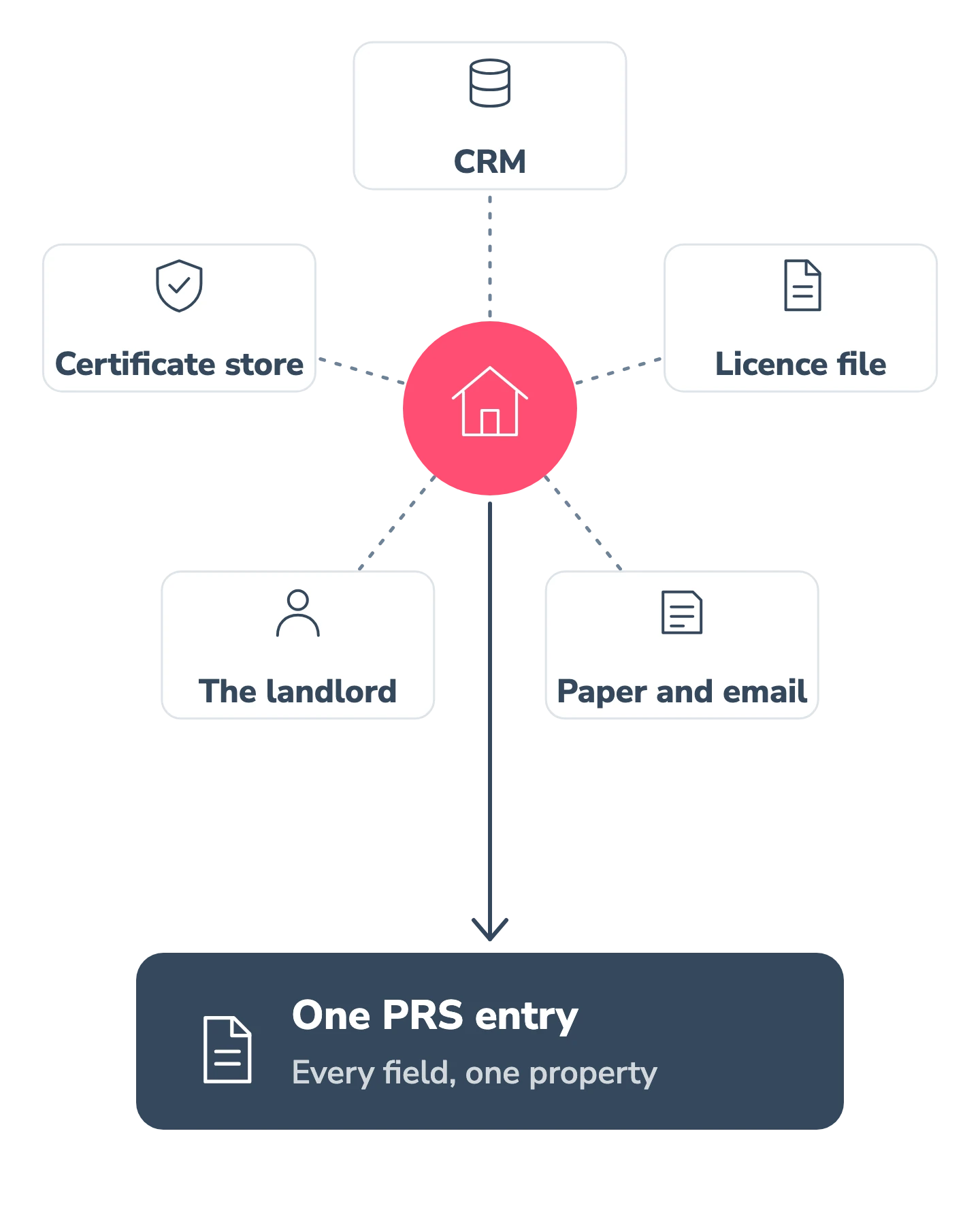
- What would a CRM export need to contain?
- What’s changed
- Frequently asked questions
What information is needed to register a rental property?
Registering a rental property on the PRS database requires information about the landlord, the dwelling and, for a let property, the tenancy and its safety and licensing status. The draft Regulations list every item in two Schedules: Schedule 2 for the landlord entry, Schedule 3 for the dwelling entry.
The landlord entry (Schedule 2) and the dwelling details in Part 1 of Schedule 3 are due when the entry is made. For a property that is already let, the tenancy and health and safety information in Part 2 of Schedule 3 may be left until later, but it must be provided before the end of 28 days beginning with the day the entry was made (draft Reg 6(2)). A property that is only intended to be let needs Part 1 alone (Reg 6(3)).
| Group | What it covers | When it is due | Who can provide it |
|---|---|---|---|
| Landlord | Schedule 2: identity and contact details; organisation and authority details where relevant | When the entry is made | The landlord |
| Property | Schedule 3, Part 1: address, ownership, type, bedrooms, whether let, freeholder or manager | When the entry is made | The landlord |
| Tenancy | Schedule 3, Part 2: occupants, households, rent, utilities, furnishing, licence type and number | Within 28 days of the entry | The landlord, or an appointed agent |
| Compliance | Schedule 3, Part 2: gas safety, electrical safety, EPC and any MEES exemption | Within 28 days of the entry | The landlord, or an appointed agent |
An appointed letting agent or property manager may provide the Part 2 information on the landlord’s behalf (draft Reg 4(5)). Nothing in the draft lets an agent provide Schedule 2 or Part 1 for the landlord. The landlord stays responsible for everything submitted.
How to read the tables
The “usually held by” column is our view of where each item normally sits in a letting agency, so you can see which records you would need to open. The Schedules say nothing about this, and your own systems may differ. Everything else in the tables comes from the draft Regulations.
- Landlord: the landlord supplies it, or it sits in the landlord’s own records
- Agent CRM: normally in the property management system or the tenancy file
- Licence file: the council licence, its application or your licensing tracker
- Certificate: a gas safety record, EICR or EIC, or EPC held on file or in a certificate store
What landlord details does the PRS database ask for?
The PRS database asks every landlord for identity and contact details, and asks organisations for more. Schedule 2 lists 19 items in three groups: individual landlords, organisational landlords, and people making the entry in a representative capacity. The landlord entry must exist before any property can be added (draft Reg 4(6)). All of it is due when the entry is made.
Individual landlord
| Field | Schedule reference | Usually held by | Note |
|---|---|---|---|
| Name | Sch 2, para 1 | LandlordAgent CRM | |
| Date of birth | Sch 2, para 2 | Landlord | Often not held by agents |
| Residential address | Sch 2, para 3 | LandlordAgent CRM | Home address, not a correspondence address |
| Telephone number | Sch 2, para 4 | Agent CRM | |
| Email address | Sch 2, para 5 | Agent CRM |
Organisation as landlord
| Field | Schedule reference | Usually held by | Note |
|---|---|---|---|
| Organisation name, or description it is known by | Sch 2, para 6 | LandlordAgent CRM | |
| Type of legal entity | Sch 2, para 7 | Landlord | For example a company, partnership or trust |
| Address | Sch 2, para 8 | LandlordAgent CRM | A PO Box is not accepted |
| Telephone number and email address | Sch 2, paras 9–10 | Agent CRM | |
| Name, date of birth, email and telephone of the individual making the entry | Sch 2, para 11 | Landlord | Date of birth is the item agents rarely hold |
| Nominated contact for the database: name, email, telephone | Sch 2, para 12 | Landlord | |
| Companies House registration number, if applicable | Sch 2, para 13 | Landlord | |
| Charity number, if applicable | Sch 2, para 14 | Landlord | |
| Names, dates of birth and addresses of directors, trustees, partners or governing body | Sch 2, para 15 | Landlord | Only where no Companies House number is given |
| Lead trustee: name, date of birth, address, email, telephone | Sch 2, para 16 | Landlord | Only where the organisation is a trust |
Someone acting for the landlord in a representative capacity
| Field | Schedule reference | Usually held by | Note |
|---|---|---|---|
| Capacity in which the entry is made, such as power of attorney, personal representative, court-appointed deputy, guardian, receiver, trustee in bankruptcy, liquidator, administrator or mortgagee | Sch 2, para 17 | The person acting | Applies only to these cases, not to agents |
| Name, address, telephone and email of that person | Sch 2, para 18 | The person acting | |
| Copy of the evidence of their authority, certified or sealed as appropriate | Sch 2, para 19 | The person acting | For example the power of attorney or grant of probate |
Where someone is acting in one of these capacities, the entry may still be made without the bedroom count and freeholder details in Part 1, and without Part 2 (Reg 6(4)). A letting agent is not in this group.
What property details does the PRS database ask for?
The PRS database asks seven things about the dwelling itself in Part 1 of Schedule 3. All are due when the dwelling entry is made, and none of them can be left to the 28-day window. A “dwelling” is a building or part of a building occupied as a separate dwelling (Renters’ Rights Act 2025, s.63(2)).
| Field | Schedule reference | Usually held by | Note |
|---|---|---|---|
| Address of the dwelling | Sch 3 Pt 1, para 1 | Agent CRM | |
| Residential landlord’s name, a correspondence address in England or Wales, and an email address for the dwelling | Sch 3 Pt 1, para 2 | Agent CRM | No PO Box. The email is specific to this dwelling |
| Ownership type | Sch 3 Pt 1, para 3 | Landlord | The draft does not define the options. See the note below |
| Dwelling type | Sch 3 Pt 1, para 4 | Agent CRM | Defined as the physical form, such as detached, semi-detached, terraced or flat (Sch 3 Pt 3) |
| Number of bedrooms | Sch 3 Pt 1, para 5 | Agent CRM | |
| Whether the dwelling is currently let | Sch 3 Pt 1, para 6 | Agent CRM | Decides whether Part 2 applies |
| Name and email of the freehold owner, any other superior landlord, or the property manager | Sch 3 Pt 1, para 7 | LandlordAgent CRM | Any of the three. A managing agent would normally appear here |
What tenancy and occupancy details does the PRS database ask for?
The PRS database asks for the number of occupants and households, the rent, what it includes, whether the home is furnished, and which licence it needs. These are the Part 2 items that describe the tenancy. They are due within 28 days of the entry, and an appointed agent may provide them (draft Reg 4(5)).

| Field | Schedule reference | Usually held by | Note |
|---|---|---|---|
| Number of occupants | Sch 3 Pt 2, para 8 | Agent CRM | Tenant records usually give this |
| Number of households | Sch 3 Pt 2, para 9 | Licence file | The field most CRMs lack. See below |
| Licence required: HMO licence, additional licence, selective licence, or none, and the licence numbers if available | Sch 3 Pt 2, para 10 | Licence file | The number, not a copy of the licence. “If available” covers an application in progress |
| Rent charged and how often it is paid | Sch 3 Pt 2, para 16(a) | Agent CRM | |
| Whether rent includes utilities, and which | Sch 3 Pt 2, para 16(b) | Agent CRM | |
| Furnished, partly furnished or unfurnished | Sch 3 Pt 2, para 17 | Agent CRM |
Why is "number of households" the hard one?
The number of households occupying a dwelling is the item most agency systems are least likely to hold. The Schedule asks for it (Sch 3 Pt 2, para 9) and gives no definition of “household”. A CRM records tenants and tenancies. A household is a different count: five sharers who are unrelated are five households, a couple and their child are one.
Licensing records are the likelier source. A council HMO or additional licence application normally asks who lives in the property and how many, so the licence file may already hold a count. Nuneaton and Bedworth’s HMO application pack, for example, asks for the number of people and the number of households living in the property (application pack). For a single-let family home, the answer is usually one, but it still has to be entered and confirmed. For anything shared, the answer has to come from the tenancy file or from a call to the landlord or tenants.
It was raised at an industry briefing in autumn 2026 that most CRMs do not hold this field; that is a statement about agents’ systems in general, not a measured figure.
What safety and compliance details does the PRS database ask for?
The PRS database asks for the gas safety record, the electrical safety report and the energy performance certificate, with dates. These are Part 2 items due within 28 days. The draft asks for copies of the documents where they exist, and for dates, and an energy-efficiency exemption if one applies.

| Field | Schedule reference | Usually held by | Note |
|---|---|---|---|
| Gas safety record copy, if one exists | Sch 3 Pt 2, para 11(a) | Certificate | Only if the dwelling has a gas supply |
| Gas safety record issue date | Sch 3 Pt 2, para 11(b) | Certificate | Only if the dwelling has a gas supply |
| EICR copy if one exists, or the appropriate EIC | Sch 3 Pt 2, para 12(a) | Certificate | The EIC option is for a newer installation |
| EICR expiry date, or EIC issue date | Sch 3 Pt 2, para 12(b) | Certificate | The expiry is the date the next inspection is due, as stated on the EICR |
| Whether the landlord had to give the current tenant a valid EPC, and a copy of the most recent EPC if one exists | Sch 3 Pt 2, para 13 | Certificate | |
| Start date of the current tenancy | Sch 3 Pt 2, para 14 | Agent CRM | Only where the most recent EPC is no longer valid |
| Whether the dwelling has a registered MEES exemption, and its type | Sch 3 Pt 2, para 15 | Landlord | Only where the EPC rating is below the minimum level of energy efficiency |
Gas, electrical and EPC details can be marked “provide this later” in the service, as shown to industry by MHCLG in autumn 2026; subject to change. The draft itself is wider: it lets the whole of Part 2 follow within the 28 days.
Does an HMO need one entry or one per room?
An HMO is registered as a dwelling entry, and the draft Schedules ask for one count of occupants and one count of households for the whole dwelling. They do not say in terms how a house let by the room is treated, so the answer below is a reading, not a settled rule.
The reasoning has four parts. Entries are made per “dwelling” (Reg 6(6): one active dwelling entry for a dwelling). A dwelling is a building or part of a building occupied as a separate dwelling (RRA 2025 s.63(2)). Schedule 3, Part 2 asks for a single “number of occupants” and “number of households” for the dwelling, which would be redundant if each room were its own entry. And paragraph 10 asks for the HMO licence number as a property-level item. Together these point to one entry per HMO, with a households count above one.
Nothing in the draft confirms this, and no government guidance has addressed it. The fee question follows from it: whether a multi-let house costs £65 or £65 per room depends on the same point. The hub owns the fee answer: How much does registration cost? →.
When is each item due, in one list?
The draft sets two deadlines. Schedule 2 and Schedule 3 Part 1 are due when the entry is made. Schedule 3 Part 2 is due before the end of 28 days beginning with the day the entry was made, and the service reminds agents at day 14 (as shown to industry by MHCLG in autumn 2026; subject to change).
Entry made
At entryLandlord details (Schedule 2) and property details (Schedule 3 Part 1) provided. The fee has to be paid first (Reg 6(5)).
Days 1 to 28
Part 2Tenancy, occupancy, licensing and safety details (Schedule 3 Part 2) provided, by the landlord or an appointed agent.
Each year
RenewalThe entry is renewed on or before its renewal date, with the fee, or it becomes inactive (Reg 10).
Get the readiness pack
Gather the data once, in the layout the service will ask for it. The pack is free.

Property registration readiness pack
Free download.
- Spreadsheet checklist. One row per property, one column per field above, with a completeness score and a 28-day due-date column.
- Terms-of-business checklist. The points to settle with landlords before you accept an appointment. Not legal advice. What should an agent’s terms of business cover?
- Workload one-pager. Hours per portfolio size, using the government and prototype-agent estimates, for your own planning or for your board.
The table above stays open. The pack only saves you rebuilding it in a spreadsheet.
What would a CRM export need to contain?
A property management export will cover some of the items. The rest sit in licence files, certificate stores and landlord correspondence. A simple test is to export your property list and count which of the 17 Schedule 3 items are already columns. The pack’s spreadsheet is laid out so you can paste your export beside it and see the gaps.
What's changed
-
Page published. Built from the draft Private Rented Sector Database Regulations 2026, Schedules 2 and 3 and Regs 4, 5, 6 and 10. Two points are marked as not yet confirmed: the ownership types the service offers, and whether an HMO is one entry.

Frequently asked questions
The draft asks for the licence type and the licence number if available (Sch 3 Pt 2, para 10). It does not ask for a copy of the licence. It does ask for copies of the gas safety record, the EICR or EIC, and the EPC, where they exist.
The gas safety items apply only if the dwelling has a gas supply (Sch 3 Pt 2, para 11). A home with no gas has nothing to enter there.
The draft asks for a copy “if one exists” (para 12). Where one does not exist, an appropriate EIC can be given instead. The EICR itself is a legal requirement for tenancies under the Electrical Safety Standards Regulations 2020, separate from this database.
Only the Part 2 items: occupants, households, licensing, rent, furnishing and the safety documents (draft Reg 4(5)). The landlord’s own details and the Part 1 property details are the landlord’s to give, and the landlord makes the final declaration.
The draft does not define it. In the housing context it counts separate groups living in the dwelling, so a couple with a child is one household and four unrelated sharers are four. We will confirm this against MHCLG guidance once it is published.
The draft points to one entry per HMO, because it asks for occupants and households as a single count for the dwelling. It does not say so in terms, and we will confirm it against MHCLG guidance.
No. The Regulations are in draft and the government may change the Schedules before they are made. We update this page when they do.
The draft sets 28 days from the date the entry was made as the limit (Reg 6(2)). It does not say what happens on a missed deadline, and we will update this page once the made Regulations are published.
Find the gaps in your licensing records before your region opens.
The licence type and number are the items agents most often cannot answer from memory.
