
The PRS database in the East Midlands: dates, deadline and licensing
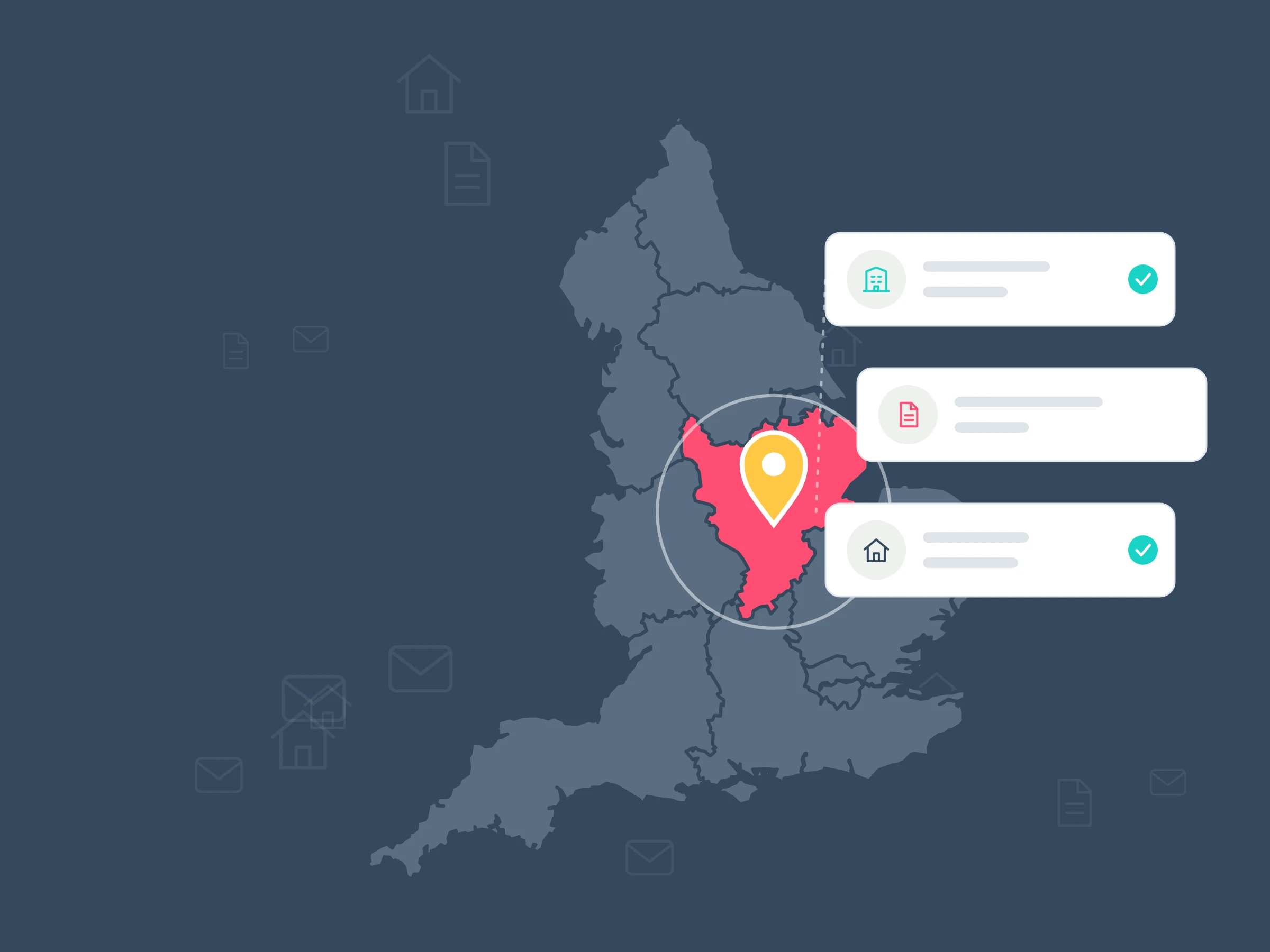
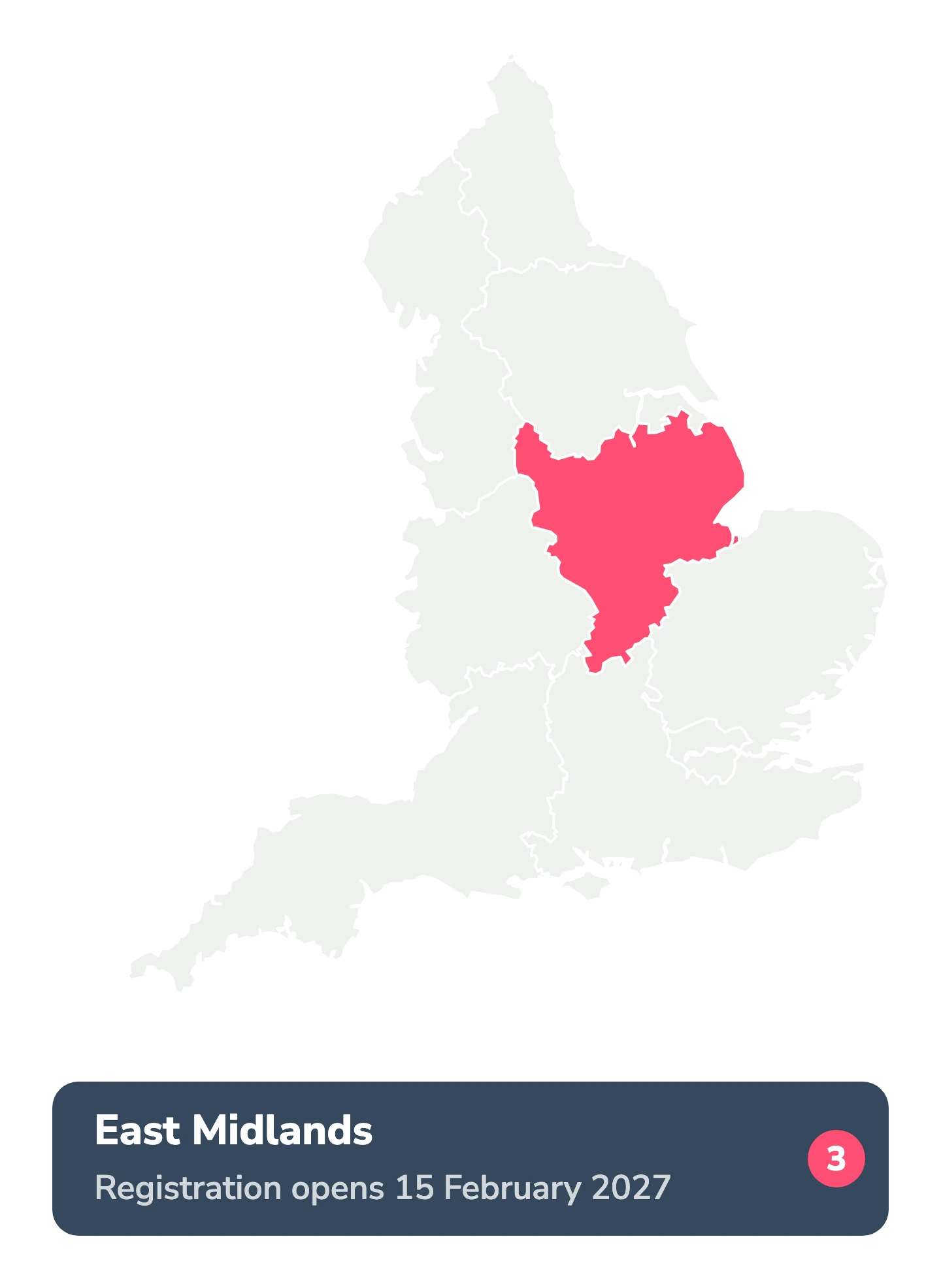
The East Midlands is the third region in England to open the PRS database. Registration opens on 15 February 2027, and every rented property in the region needs an entry by 14 May 2027.
On this page
- When do you have to register in the East Midlands?
- Which councils are in the East Midlands region?
- Which East Midlands councils run selective or additional licensing?
- Do any East Midlands licensing schemes start or end during the registration window?
- What do East Midlands councils say about the schemes that end in 2027 and 2028?
- Which East Midlands licensing schemes are new?
- How do Nottingham and Leicester differ?
- What have East Midlands councils said about the PRS database?
- What should letting agents in the East Midlands do before 15 February?
- Where can you read each council’s licensing rules?
- How much does registration cost, and what do you need to provide?
- What’s changed
- Frequently asked questions
When do you have to register in the East Midlands?
Landlords in the East Midlands must register each rented property between 15 February 2027 and 14 May 2027. The deadline depends on where the property is, not where the landlord or agent is based. A portfolio that spans more than one region has more than one deadline, set out in the national rollout table.
The window is 89 days and contains 62 working days once Good Friday, Easter Monday and the early May bank holiday are taken out. The deadline falls on a Friday, a working day, so Friday 14 May 2027 is the last working day for anything that needs a colleague, a landlord’s reply or a council’s answer.
The date to register by is the end of the three-month window the government publishes on the Housing Hub, after which councils in the region can begin enforcement. The draft Regulations fix when each region opens, not a date to register by. The dates were announced by the government (GOV.UK, 9 September 2026). The East Midlands borders both the West Midlands and the East of England, which open on 15 December 2026 and 15 January 2027. An agent with stock across those borders will be working to up to three overlapping windows.

Which councils are in the East Midlands region?
The East Midlands region has 35 local authorities. The draft Regulations list the councils in each region (Schedule 1), by the council areas as they stood on 15 December 2026. It covers Derbyshire, Leicestershire, Lincolnshire, Northamptonshire, Nottinghamshire and Rutland, including the unitary authorities of Derby, Leicester, Nottingham and Rutland and the two Northamptonshire unitaries. North Lincolnshire and North East Lincolnshire are not here: Schedule 1 places them in Yorkshire and Humber, and they register on that region’s dates.
| Area | Councils | Licensing beyond mandatory HMO |
|---|---|---|
| Derbyshire | Amber Valley, Bolsover, Chesterfield, Derby, Derbyshire Dales, Erewash, High Peak, North East Derbyshire, South Derbyshire | None live |
| Leicestershire and Rutland | Blaby, Charnwood, Harborough, Hinckley and Bosworth, Leicester, Melton, North West Leicestershire, Oadby and Wigston, Rutland | Charnwood, Leicester and Oadby and Wigston |
| Lincolnshire | Boston, East Lindsey, Lincoln, North Kesteven, South Holland, South Kesteven, West Lindsey | None live |
| Northamptonshire | North Northamptonshire, West Northamptonshire | West Northamptonshire |
| Nottinghamshire | Ashfield, Bassetlaw, Broxtowe, Gedling, Mansfield, Newark and Sherwood, Nottingham, Rushcliffe | Ashfield, Gedling, Mansfield and Nottingham |
Which East Midlands councils run selective or additional licensing?
Eight of the East Midlands’s 35 local authorities run selective or additional licensing on Kamma’s data at 6 October 2026: Ashfield, Charnwood, Gedling, Leicester, Mansfield, Nottingham, Oadby and Wigston and West Northamptonshire. Between them they hold 12 live schemes. The other 27 councils require a licence only for mandatory HMOs, which applies in every council. That includes Derby, Lincoln, Chesterfield and North Northamptonshire.
Selective licensing covers most privately rented homes in a designated area. Additional licensing covers smaller HMOs that the national mandatory rule leaves out. Both matter for the database, because each registration records the property’s licence type and number (what that means for enforcement). Coverage below is as recorded in our data; check the council’s own map before relying on a specific street.
| Council | Scheme | Runs to | Coverage |
|---|---|---|---|
| Ashfield | Selective | 24 July 2027 | Parts of 2 wards: Central & New Cross, Stanton Hill & Teversal |
| Charnwood | Selective | 31 March 2028 | Areas of Loughborough (the former Lemyngton and Hastings wards) |
| Charnwood | Additional | 31 March 2028 | Whole council area |
| Gedling | Selective | 31 October 2027 | Parts of 4 wards |
| Gedling | Selective | 4 January 2030 | Parts of 1 ward: Netherfield |
| Leicester | Selective | 9 October 2027 | Parts of 3 wards: Fosse, Stoneygate, Westcotes |
| Leicester | Selective | 9 October 2027 | Parts of 6 wards |
| Mansfield | Selective | 12 September 2030 | Parts of 8 wards |
| Nottingham | Selective | 30 November 2028 | Parts of the city |
| Nottingham | Additional | 31 December 2028 | Whole council area |
| Oadby and Wigston | Selective | 9 November 2030 | 1 ward, and parts of 4 more |
| West Northamptonshire | Additional | 23 February 2030 | Selected areas |
Dates in bold are schemes that end within a year of the registration deadline.
Nottingham and Leicester, the region’s two largest letting markets, hold four of the 12 live schemes between them. Derby has none in our data.
Do any East Midlands licensing schemes start or end during the registration window?
No licensing scheme in Kamma’s data starts or ends between 15 February 2027 and 14 May 2027. The window closes just before a run of expiries. Six live schemes in four councils end within a year of the deadline, the first of them Ashfield’s on 24 July 2027, 71 days after registration closes. None has a replacement designation in our data, so agents there should confirm with each council what follows.
A licence is still needed while a scheme runs, and a council that wants to continue or add one must consult and designate. In this region, Mansfield’s consultation on selective licensing closed on 16 December 2024 and its scheme began on 13 September 2025. Our data also records selective licensing consultations by Bassetlaw (2019) and West Lindsey (2022) and no scheme in either. A consultation is not a scheme, and nothing here applies until a council designates.

| When | What | Council |
|---|---|---|
| 15 February 2027 | Registration opens | |
| 14 May 2027 | Registration deadline | |
| 24 July 2027 | Ashfield's selective scheme ends | Ashfield |
| 9 October 2027 | Leicester's selective scheme ends | Leicester |
| 31 October 2027 | Gedling's selective scheme ends | Gedling |
| 31 March 2028 | Charnwood's additional and selective scheme ends | Charnwood |
What do East Midlands councils say about the schemes that end in 2027 and 2028?
Four councils have schemes that end soon after the deadline, and their own pages say different things. None of the council pages and reports we read for them announces a renewal, a replacement or a consultation. That is a statement about those pages on the day we checked, and a council can start a consultation at any time.
| Council | Scheme | Last day in force | After the deadline | Coverage |
|---|---|---|---|---|
| Ashfield | Selective | 24 July 2027 | 71 days | Parts of 2 wards: Central & New Cross, Stanton Hill & Teversal |
| Leicester | Selective | 9 October 2027 | 148 days | Parts of 3 wards: Fosse, Stoneygate, Westcotes |
| Leicester | Selective | 9 October 2027 | 148 days | Parts of 6 wards |
| Gedling | Selective | 31 October 2027 | 170 days | Parts of 4 wards |
| Charnwood | Additional | 31 March 2028 | 322 days | Whole council area |
| Charnwood | Selective | 31 March 2028 | 322 days | Areas of Loughborough (the former Lemyngton and Hastings wards) |
Ashfield. The council’s page says: “The designation is expected to run until 25 July 2027” (council page). Our data records the last day in force as 24 July 2027. The two agree if the council’s “until” means the day the designation lapses, which is our reading and not something the council states.
Leicester. Both selective schemes end on 9 October 2027. The council’s page says: “The licensing scheme will be reviewed in October 2027” (council page). A review is not a renewal, and the page does not say which way it will go.
Gedling. The older selective scheme, begun on 1 November 2022, ends on 31 October 2027. A second scheme covering Netherfield began on 5 January 2025 and runs to 4 January 2030. It was put to the council’s Cabinet in a report that followed a 12-week public consultation (Cabinet report). Our data shows both running at once, so a Gedling property needs the right scheme checked by address.
Charnwood. The council’s selective licensing page says of the scheme: “It will last for five years unless the scheme is renewed” (council page). Its additional licensing notice says the designation, “unless revoked beforehand or extended will cease to have effect on March 31, 2028” (public notice). The additional scheme covers the whole borough, so every three- or four-person HMO in Charnwood is inside it while it runs.
Which East Midlands licensing schemes are new?
Four of the region’s 12 live schemes, in four councils, began on or after 1 January 2025. Gedling designated a Netherfield scheme, West Northamptonshire renewed and widened an additional scheme that already existed, and Mansfield and Oadby and Wigston each designated new areas for selective licensing. The table shows the schemes as our data records them, with the council source for each.
| Council | Scheme | Started | Runs to | Coverage | Source |
|---|---|---|---|---|---|
| Gedling | Selective | 5 January 2025 | 4 January 2030 | Parts of 1 ward: Netherfield | Council cabinet report |
| West Northamptonshire | Additional | 24 February 2025 | 23 February 2030 | Selected areas | Council HMO page |
| Mansfield | Selective | 13 September 2025 | 12 September 2030 | Parts of 8 wards | Council announcement |
| Oadby and Wigston | Selective | 10 November 2025 | 9 November 2030 | 1 ward, and parts of 4 more | Council scheme page |
West Northamptonshire’s HMO page says the new scheme “includes the area covered by the 2020 to 2025 Additional Licensing Scheme and additional areas in Northampton and Daventry” (council HMO page). Oadby and Wigston’s scheme follows an earlier South Wigston scheme that ran for five years (council scheme page), so an address licensed before 2025 may now sit in a different designation.
How do Nottingham and Leicester differ?
Nottingham runs two schemes that together reach most of the city. Its selective scheme began on 1 December 2023 and, in the words of the sealed designation, “shall cease to have effect on 30 November 2028” (designation). Its additional scheme began on 1 January 2024 and, on the council’s page, is “now citywide”, estimated to include “over 2,300 privately rented HMOs” (council page). Our data records the selective scheme as parts of the city. Both run to late 2028, more than a year after the deadline, so Nottingham has no expiry in the window or the year after it.
Leicester is the opposite case: it holds no additional scheme in our data, and its two selective schemes (recorded as parts of 3 wards: Fosse, Stoneygate, Westcotes and parts of 6 wards) end together in October 2027. Both cities have Kamma guides: Nottingham and Leicester.
What have East Midlands councils said about the PRS database?
Councils in this region have said little about the database on their public pages so far. Neither Nottingham’s Renters’ Rights hub nor Leicester’s selective licensing page mentions it when we checked on 6 October 2026. The clearest statement we found is from Blaby District Council, which has no scheme in our data.
Blaby’s Scrutiny Commission recorded an officer overview on 17 June 2026 of what the Renters’ Rights Act means for the council. Among the impacts on the council it lists: “Administer the national Private Rented Sector (PRS) database locally”. Among the impacts on landlords it lists: “Mandatory registration on national database”. The record also says the council’s finance model “would be partly self-funded, and through the PRS database”, and that the district has “over 5,400” private rented properties (Blaby decision record). The record gives no database dates.
That the database fee is expected to fund part of local enforcement is the council’s own statement, in the words above. What a council will do with the data once it holds it, none of these pages say. Our reading is that councils with live schemes will use the register to check licence numbers, but that is inference, and no council has said it.

What should letting agents in the East Midlands do before 15 February?
Work out which of your managed properties sit inside a live licensing scheme, and gather each licence number before your landlords are asked for it. Each registration asks for licence type and number under a false-information warning, so a missing or wrong licence record becomes a problem at the point of declaration. Licensing offences on or after 1 May 2026 carry civil penalties of up to £40,000 (Housing Act 2004, s.249A) and rent repayment orders of up to 24 months’ rent.
- Match every managed address to the eight councils above and flag those inside a scheme’s wards
- Record licence numbers and end dates, starting with Ashfield, Charnwood, Gedling and Leicester, whose schemes end within a year of the deadline
- Check Gedling by address, because two selective schemes run there at once
- Confirm what properties in the other councils need: mandatory HMO licences only
- Plan the entry work around the Easter weeks and the early May bank holiday, using the workload calculator
- Read what you need to gather before invitations start arriving
For the agent’s role in the process, see what a letting agent can and cannot do on the PRS database.
Where can you read each council's licensing rules?
Kamma publishes a licensing guide for eight East Midlands councils: every council in the region with a live scheme. Each guide sets out the scheme, wards covered, fees and how to apply. The other councils in the region have no scheme beyond mandatory HMO licensing, so there is no guide to link.
How much does registration cost, and what do you need to provide?
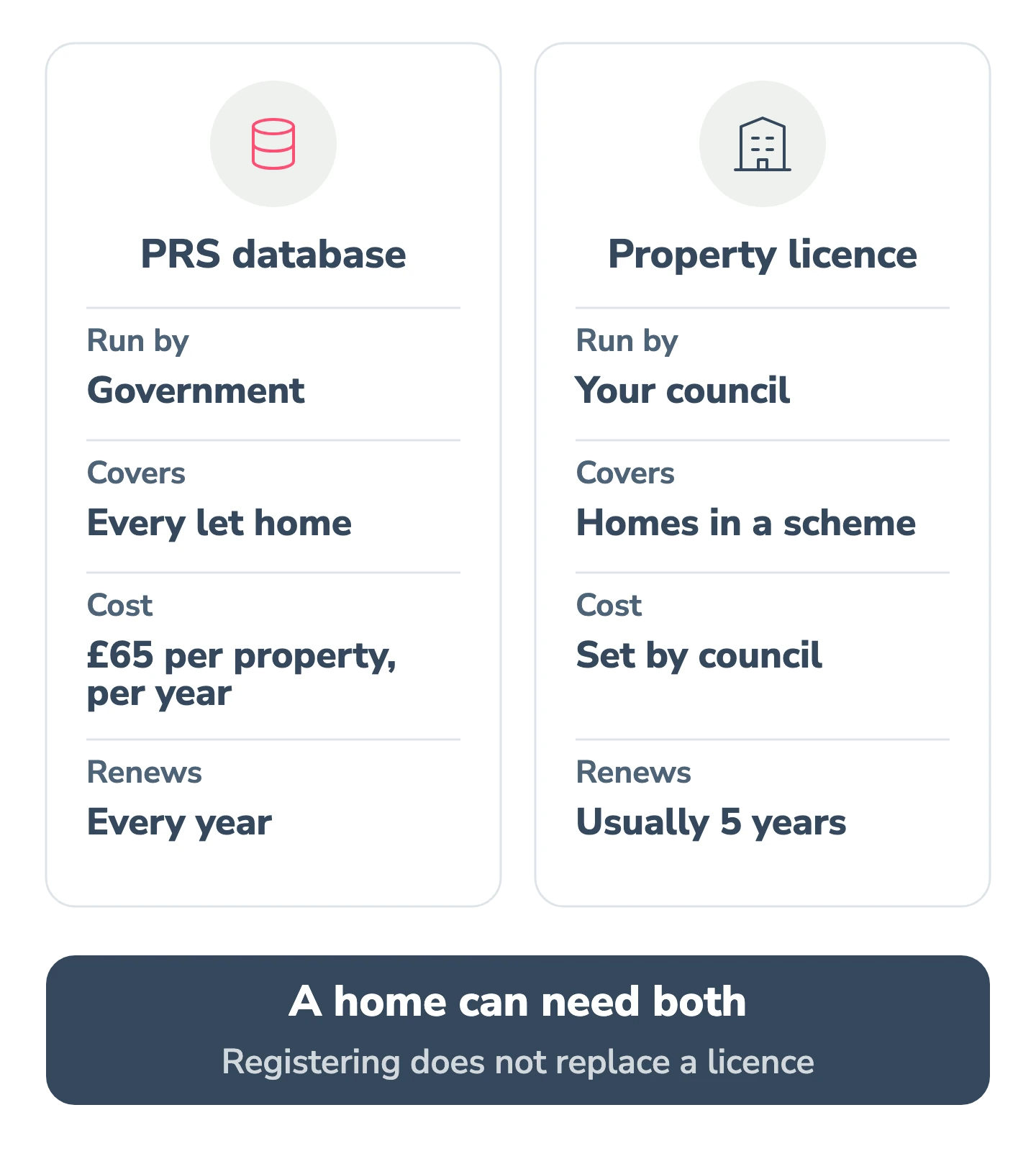
Registration costs £65 per property per year, and each entry asks for landlord, property, tenancy and compliance details. The full answers sit in the national guides, so they are not repeated here: see how much the PRS database costs and which information registration asks for.
What's changed
-
Page published. Licensing data checked against council sources on 6 October 2026.

Frequently asked questions
The region has 35 local authorities, as listed in Schedule 1 of the draft Regulations: Derbyshire, Leicestershire, Lincolnshire, Northamptonshire, Nottinghamshire and Rutland, with Derby, Leicester and Nottingham as unitary authorities. North Lincolnshire and North East Lincolnshire are in Yorkshire and the Humber, not here. A property’s council decides its region.
Registration asks for the licence type the property needs on the day you submit. Ashfield, Charnwood, Gedling and Leicester each hold a scheme that ends within a year of the deadline, the first on 24 July 2027. They are all still in force when registration closes, and we hold no replacement designation for any of them. Check each council’s page on the day you submit.
Not on the dates we hold. No scheme starts or ends between 15 February 2027 and 14 May 2027, though a council can designate a new one at any time and must give notice first. Keep your entry up to date if a property becomes licensable.
No. The service opens on 15 February 2027 for the East Midlands. The national guide covers early registration and the full rollout.
Find out which of your East Midlands properties are licensable before 15 February.
Get the licensing gaps in your portfolio before your region’s deadline.
